Interactive simulation · free
E-motorthe rotating magnetic field
Three alternating currents, 120° apart, add up to one field that turns at constant strength. That is why an electric motor spins. Watch it happen, freeze it, step through it, cut a phase and see what breaks.
- 3 and 6 phases
- English and Albanian
- Computer and phone
- No installation, no sign-up
A look at the simulator
Phase vectors, the resultant R and its trail on the left, controls on the right. On a phone the controls move below the picture and respond to tap, swipe and long press.
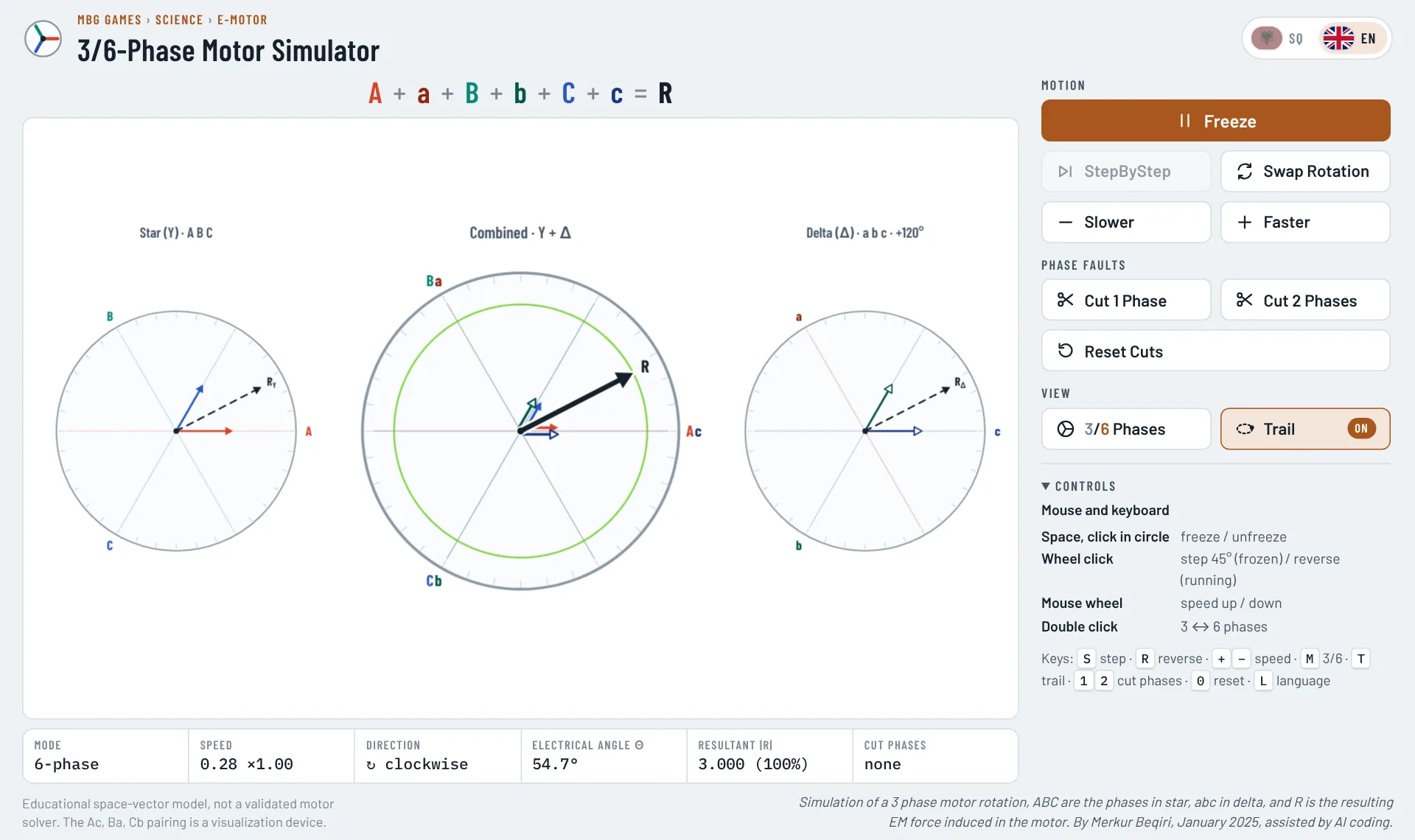
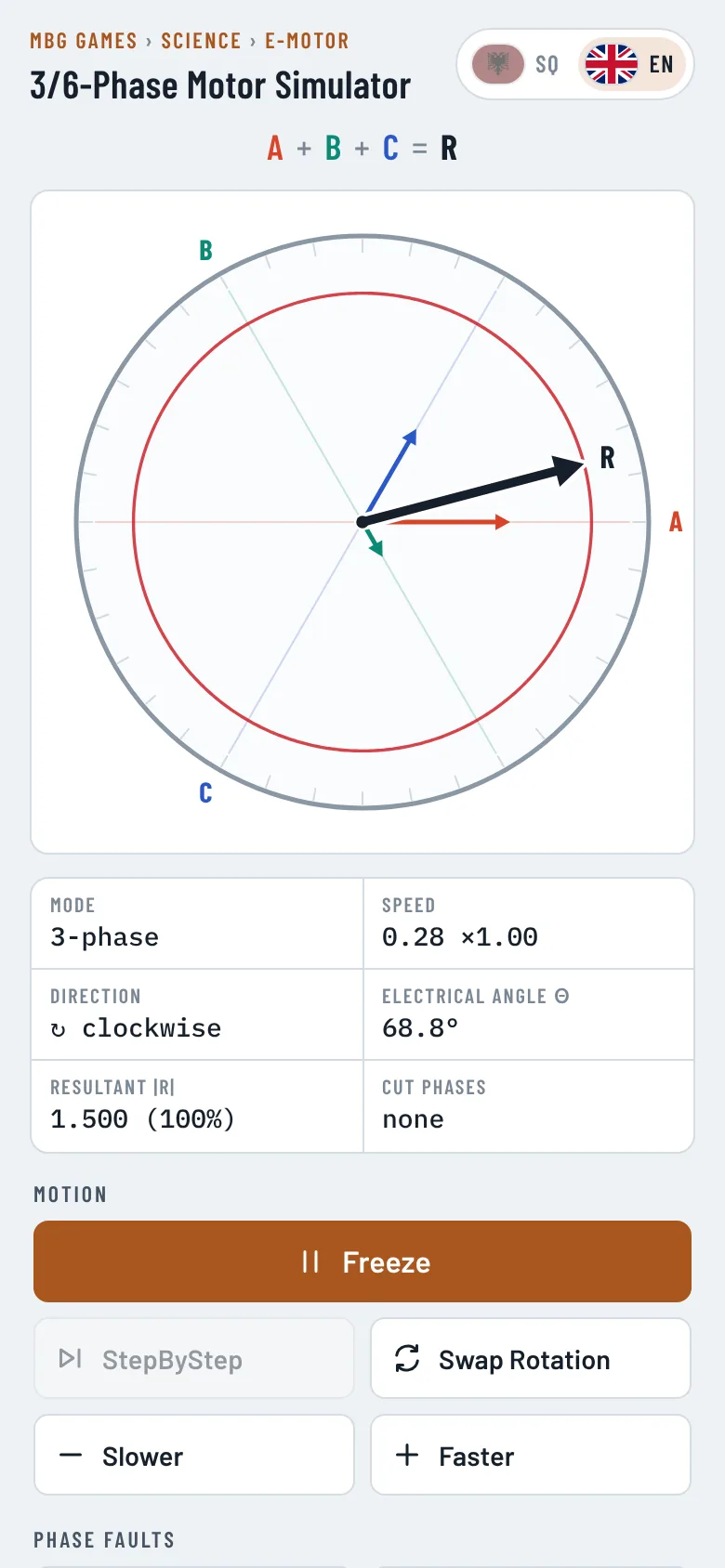
What it shows
Three phases
Phases A, B and C sit on axes 120° apart. Each one only grows and shrinks along its own axis, yet their sum R turns around the circle without changing length. Its trail is a perfect circle.
Six phases: star and delta
A second three-phase set a, b, c (delta) joins the star set A, B, C. Three synchronized circles show Star, Delta and the Combined field, where the pairs Ac, Ba and Cb reinforce each other and R doubles.
Phase faults
Cut one or two phases at random. The field is no longer a clean rotation: R grows and shrinks, and its trail becomes an ellipse or a line. This is what a motor goes through when it loses a phase.
The equation behind it
Each phase k has an axis at angle θk = 0°, 120°, 240° and carries a current sin(t + θk). Its contribution is a vector along its own axis:
// phase k, axis θk
Vk(t) = sin(t + θk) · [cos θk, sin θk]
// the resultant
R(t) = VA + VB + VC
// balanced: constant length
|R| = 1.5
Adding the three gives R = 1.5 · [sin t, cos t]: a vector of length 1.5 that turns once per electrical cycle. The simulator shows |R| live, so you can check that it stays at 1.500 (100 %) until you cut a phase.
How to use it
Every action has a button. On a computer there are also keys and mouse shortcuts, on a phone touch gestures.
| Action | Button | Keyboard and mouse | Touch |
|---|---|---|---|
| Freeze / continue | Freeze, Unfreeze | Space, click in a circle | Tap |
| One 45° step (while frozen) | StepByStep | S, wheel click | Long press |
| Reverse the rotation | Swap Rotation | R, wheel click while running | Long press while running |
| Faster / slower | Faster, Slower | + −, mouse wheel | Swipe up or right / down or left |
| 3 ↔ 6 phases | 3/6 Phases | M, double click | Double tap |
| Trail on / off | Trail | T | – |
| Cut phases / restore them | Cut 1 Phase, Cut 2 Phases, Reset Cuts | 1 2 0 | – |
| English ↔ Albanian | Flag button | L | – |
For teachers and students: four experiments
Freeze and add
Freeze the simulation and step 45° at a time. At each step add the three arrows by hand, tip to tail, and check that the sum is R.
Constant length
Watch the |R| reading while it runs. Why does it stay at 1.500 when every single phase keeps changing?
Lose a phase
Cut 1 phase with the trail on. Describe the new trail. What does it mean for the turning force of the motor?
Turn it around
Swap the rotation. On a real three-phase motor the same is done by swapping any two of the three supply wires.
Questions and answers
Why does the magnetic field rotate?
Because the three currents reach their peak one after another, a third of a cycle apart, on axes a third of a circle apart. The point of strongest field moves from one axis to the next, so the field turns. This idea, found by Galileo Ferraris and Nikola Tesla in the 1880s, is the basis of the induction motor.
Why does R keep the same length?
With three equal phases 120° apart, the parts that would make R pulse cancel exactly. What remains is a vector 1.5 times the peak of one phase, turning at constant speed. Real motors use this to produce a smooth turning force.
What happens when a phase is lost?
The remaining phases make a field that pulses instead of turning smoothly (an ellipse in the simulator). A real motor that loses a phase while running may keep turning, but it draws more current, heats up and vibrates. From standstill it usually cannot start.
Is this an engineering design tool?
No. It is an educational space-vector model. The six-phase star/delta pairing (Ac, Ba, Cb) is a way of showing the two groups, not a validated model of a real winding.
Does it work on a phone?
Yes, in any current browser on Android, iPhone, Windows, Mac or Linux. There is nothing to install, no account and no data collection.
Is it free?
Yes, completely.
Ready to see it turn?
Open the simulator and press Freeze at any moment.